June 14, 2026·15 min readmediation conflict resolutionconflict resolution trainingworkplace mediation
A disagreement rarely starts with shouting. More often, it starts with a small moment that nobody handles well. A coworker cuts you off in a meeting. A teacher feels undermined by a parent email. Two students keep “joking” at each other until one stops feeling safe. At home, one person says, “You never listen,” and the other hears, “You're the problem.”
Then people do what untrained people usually do. They avoid, defend, explain, recruit allies, or go silent.
That's why mediation conflict resolution training matters. It doesn't make conflict disappear. It teaches people how to move through conflict without making it worse. Done well, it gives people a reliable process, language for hard conversations, and enough repetition that calm responses become a skill rather than a lucky accident.
From Conflict Avoidance to Resolution Skill
Conflict skill is often considered to mean “being calm” or “communicating better.” That's only part of it. Calm without structure often turns into polite avoidance. Better words without better process often turn into more complex arguing.
Mediation conflict resolution training teaches something more practical. It teaches people how to slow a conflict down, separate facts from interpretations, uncover what each person needs, and move toward an agreement people can live with. That's useful in a manager-employee tension, a peer dispute at school, a family disagreement, or a community conflict where everyone still has to see each other afterward.
A simple analogy helps. Conflict is like driving in heavy rain. Good intentions matter, but they aren't enough. You need visibility, braking distance, and a route. Training provides that route.
Conflict is normal. Escalation is often learned. Resolution can be learned too.
People often get confused about the role of mediation. They assume a mediator solves the problem for the parties. In practice, the mediator manages the conversation so the parties can think more clearly and make better decisions. That's a big shift. The goal isn't to decide who's right in the abstract. The goal is to create conditions where people can speak, hear, and choose.
Three ideas make this training especially valuable:
It turns instinct into method. Instead of reacting, people learn what to do first, second, and third.
It improves repeated relationships. In workplaces and schools, most conflicts happen among people who must keep interacting.
It supports implementation. A workshop is helpful, but organizations need practice routines, refreshers, and tools that help people use the skill when emotions spike.
That last point matters more than many leaders expect. Training fails when it stays in the classroom. It succeeds when people can apply it on Tuesday afternoon, in the actual conversation they've been postponing.
The Foundations of Mediation Training
Mediation training gives people the grammar of healthy conflict. Without grammar, people still speak, but they speak in fragments, assumptions, and interruptions. With grammar, they can build meaning together.
Why training changes outcomes
This isn't a niche skill. A widely cited workplace conflict dataset reports that 85% of employees experience some kind of conflict, 60% of employees never received basic conflict-management or conflict-resolution training, and 95% of those who did receive training said it helped them address workplace conflict constructively and pursue mutually beneficial outcomes according to workplace conflict statistics summarized by Pollack Peacebuilding.
Those numbers explain why strong organizations treat conflict skill like leadership skill. If conflict is common and training helps, then training stops being optional.
The deeper reason is simple. Most conflict conversations fail for process reasons before they fail for content reasons. People talk over each other. They respond to accusations instead of underlying concerns. They push for solutions before the other person feels heard. Training interrupts those habits.
Practical rule: Don't rush to fix what you haven't accurately understood.
What mediation training actually teaches
People sometimes hear terms like neutrality, confidentiality, and voluntary participation and think mediation is soft. It isn't soft. It is disciplined. The mediator doesn't erase disagreement. The mediator creates enough order that disagreement becomes usable.
That's why I often compare mediation training to coaching a team before a difficult match. A coach doesn't play the game for the team. A coach gives the team structure, roles, and repeatable responses under pressure. Mediation training works the same way.
Core ideas usually include:
Neutral process management. The mediator stays focused on fairness in the conversation, not on taking over the decision.
Confidential space. People speak more openly when they know the process protects privacy appropriately.
Party ownership. Durable agreements are usually the ones participants help shape.
Voluntary engagement. People are more likely to follow through when they choose the path rather than having it imposed.
For readers who want to sharpen the communication side of this work, WeUnite's article on empathetic communication in conflict is useful because empathy in mediation is not agreement. It's accurate understanding.
That distinction trips people up all the time. You can understand someone's fear, frustration, or anger without endorsing every conclusion they draw from it.
The Core Curriculum What You Will Learn
A good course doesn't just tell people to “listen better.” It builds specific capacities. One widely used model breaks conflict-resolution competence into five operational domains, described in Positive Psychology's overview of conflict resolution training.
Five skill domains that build competence
The five domains are conflict analysis, effective communication, problem-solving and negotiation, emotion regulation, and moving to action. That framework matters because it prevents training from becoming a vague lesson in niceness.
Conflict analysis means learning to see the structure under the argument.
Two people may be fighting about meeting times, but the underlying conflict could be role ambiguity, workload imbalance, or a decision process nobody agreed to. Trainees learn to ask, “What is this conflict about on the surface, and what keeps feeding it underneath?”
Effective communication means more than staying polite. It includes active listening, paraphrasing, reframing, and speaking in ways that lower defensiveness. For example, “You ignored my input” might be reframed as “You want a more reliable way for your ideas to be considered before decisions are final.”
After the basics, seeing the skill in action helps. This short video is a helpful companion for learners who want a practical visual reference.
Problem-solving and negotiation teaches people how to stop arguing about positions and start building options. A position says, “I need remote work every Friday.” An interest says, “I need uninterrupted focus time and flexibility for caregiving.” Once interests are visible, more solutions become possible.
Emotion regulation is where many difficult conversations are won or lost. People don't need to become emotionless. They need to notice escalation early, slow their speech, use grounding techniques, and avoid turning a moment of hurt into a permanent story about the other person's character.
Moving to action is the often-missed final domain. A conversation may feel productive and still fail later because nobody defined next steps, timing, responsibilities, or follow-up. Resolution needs a bridge from insight to action.
Why these skills work together
A common mistake in beginner training is over-focusing on empathy alone. Empathy matters, but empathy without analysis can become sympathy without clarity. Analysis without emotion regulation can become a cold interrogation. Negotiation without follow-through creates fragile agreements.
The strongest mediators don't rely on one gift. They combine observation, language, emotional steadiness, and disciplined follow-up.
That combination is what creates genuine competence. You're not just learning how to survive one difficult conversation. You're learning how to build a repeatable practice.
Choosing Your Training Delivery Format
The best training format depends on who needs the skill, how often they'll use it, and what kind of support they need after the training day. A workplace manager, a school counselor, and a volunteer peer mediator won't need the same setup.
How the main formats differ
Some organizations still do best with a live workshop. In-person sessions make role-play easier, and trainers can intervene in real time when participants slip into blame, rescuing, or avoidance. That format is especially useful when the group already works together and needs shared language.
Schools often benefit from peer mediation models. Students usually learn best through short, repeated practice with scenarios they recognize. The point isn't to create miniature legal professionals. It's to help students structure difficult conversations, involve adults appropriately, and develop habits of listening and repair.
Online and AI-assisted formats fit a different problem. They help when people need continuity, flexible access, private reflection, or support between live sessions. They can also help distributed teams and campuses where scheduling everyone in one room is hard.
Format
Best For
Scalability
Cost
Key Advantage
In-person workshops
Leadership teams, HR groups, staff cohorts
Moderate
Moderate to high
Live role-play and immediate coaching
School-based peer programs
Students, counselors, pastoral care teams
High within a school system
Moderate
Repeated practice in familiar conflict settings
Online or AI-assisted training
Remote teams, mixed schedules, ongoing refreshers
High
Often flexible
Easy access and continuity between incidents
How to decide what fits
Use three filters.
Practice intensity: If people must mediate live disputes soon, choose a format with strong role-play and feedback.
Access needs: If schedules, geography, or privacy concerns block participation, online delivery may work better.
Sustainment plan: If people learn once and never rehearse again, the gains fade fast.
Blended models often work well because they divide the job properly. A facilitator can teach the hard parts live, then short digital refreshers can keep the language and sequence fresh. If your team is designing internal learning resources, this guide to training video production for L&D is useful for thinking through how to build short practice content employees will revisit.
Don't choose format by trend. Choose it by transfer. The right question is not, “What looks modern?” The right question is, “What will help our people use the skill in a real conflict?”
From Theory to Practice Sample Lessons and Exercises
Training becomes real when people can feel the rhythm of a mediated conversation. The process matters because it prevents the conversation from collapsing into interruption, rebuttal, or emotional flooding.
A sample mediation lesson flow
A classic mediation sequence includes planning, a mediator introduction with ground rules, uninterrupted opening statements, joint clarification, private caucuses when needed, and negotiation toward agreement. The Program on Negotiation describes this sequence clearly in its overview of what to expect from mediation training.
Here's what that looks like in plain language.
A trainer gives participants a scenario: two coworkers are stuck in a cycle of resentment. One thinks the other withholds information. The other thinks every update turns into criticism. Before anyone speaks, the mediator plans. What are the issues? What ground rules will help? What would make the room feel safe enough for honest conversation?
Then the mediator opens the session. The rules are simple. One person speaks at a time. No interruptions. No personal attacks. The aim is understanding first, problem-solving second.
Let each person empty their backpack before asking them to carry a solution.
Opening statements come next. Each person describes the conflict without interruption. This step confuses beginners because it can feel slow. But it works for a reason. People who haven't felt heard usually can't negotiate well.
The mediator then clarifies. “When you say you were left out, what specifically happened?” “When you say the feedback felt public, where did that happen?” If emotion spikes or one person shuts down, a private caucus may help. After that, the mediator brings the parties back together to generate options and shape a clear agreement.
Exercise one: Reframing accusation into observation Write a charged sentence on a board: “You never respect my time.” Ask participants to convert it into language a mediator could work with. A strong reframe might be: “Punctuality and predictability matter to you, and recent delays have affected trust.” This teaches a core move in mediation. Don't erase emotion. Translate it into workable meaning.
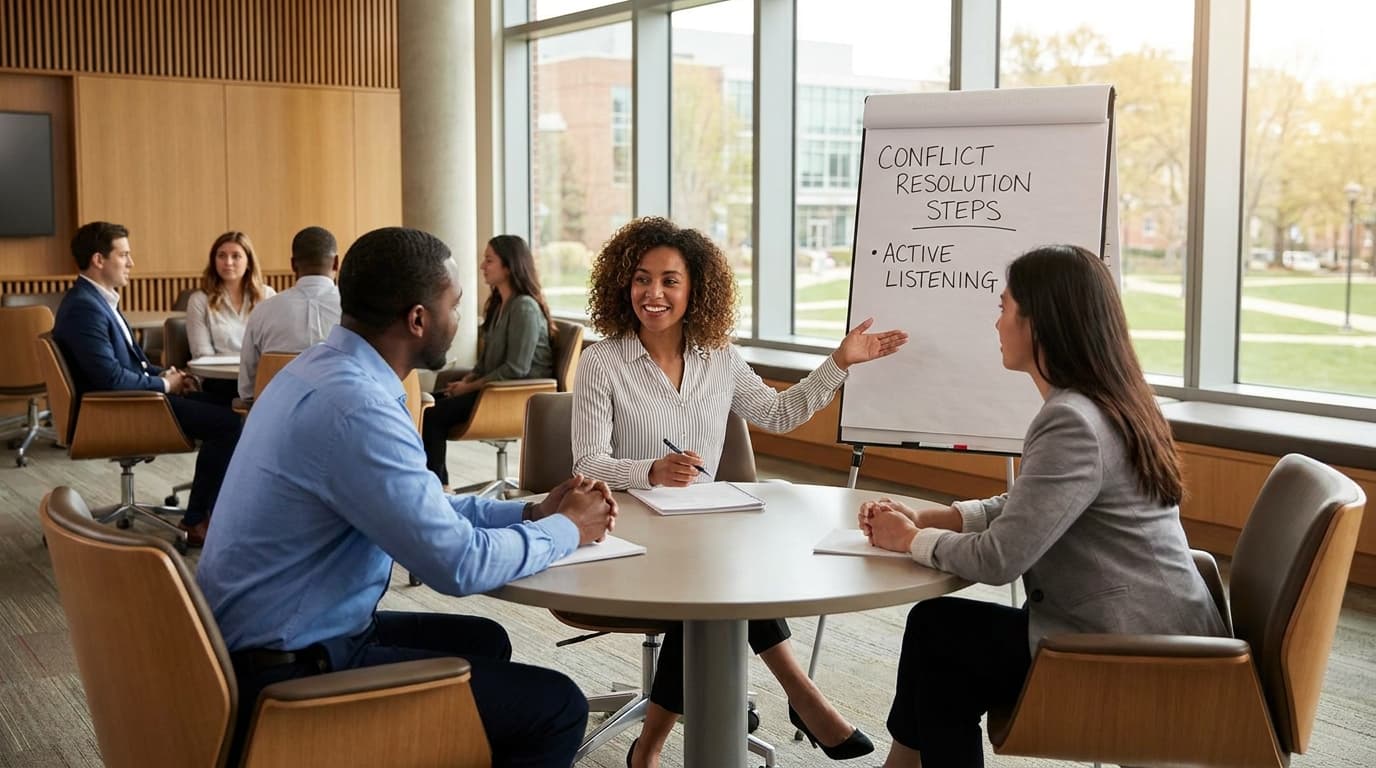
Exercise two: The active listening relay Pair people up. Speaker A gets one minute to describe a real but low-stakes frustration. Listener B can't fix, advise, or defend. Listener B may only summarize: “What I'm hearing is…” Then Speaker A scores the summary for accuracy and adds what was missed. This drill shows how often people confuse listening with waiting to respond.
These exercises work because they isolate one skill at a time. People improve faster when they practice one move clearly before combining many moves in a live scenario.
Implementing Training in Your Organization
Training only changes culture when leaders build a path from workshop to daily use. That path looks different in a workplace, a school, or a faith community, but the implementation logic is similar. Start with buy-in, choose a program that fits real conflicts, and reinforce the behavior after training ends.
A major gap in many programs is that they treat conflict as if both parties enter the room with equal comfort, equal status, and equal safety. Advanced mediation training asks a harder question: what happens when there are power imbalances, trauma responses, or identity-based dynamics in the room? Resolution Washington's description of basic mediation training and its limits highlights why neutrality alone is not enough when a conversation is structurally unequal.
Workplaces
In organizations, buy-in starts with managers. If leaders still reward avoidance, side conversations, or public correction, no course will fix the culture.
A practical workplace rollout often looks like this:
Secure leadership agreement: Define when mediation is appropriate, who can facilitate, and what issues still require formal HR processes.
Choose role-specific training: Managers need conflict coaching and early intervention skills. HR may need stronger process design and referral judgment.
Build reinforcement: Add debrief templates, team norms, and refreshers so the language shows up in daily operations.
Schools need training that matches developmental reality. Students need direct, concrete language. Staff need a shared response when peer conflict begins to affect safety, attendance, or classroom trust.
Good school implementation usually includes:
Adult alignment first: Counselors, teachers, and administrators need common ground rules and referral criteria.
Peer mediation structure: Student mediators need supervised practice, not just a badge and a script.
Psychological safety checks: Students should never be pushed into dialogue when fear, coercion, or humiliation is active.
Faith communities and other relationship-based settings
These groups often value reconciliation, but that can create pressure to “make peace” too quickly. Mediation training helps communities distinguish repair from forced harmony.
Equity sometimes requires more than equal speaking time. It may require stronger protection for the person with less power.
In congregations, volunteer groups, and community organizations, choose training that explicitly addresses confidentiality, role boundaries, and trauma awareness. A peacemaker who ignores fear or status differences can accidentally deepen harm while trying to help.
Measuring Success and Sustaining Skills with WeUnite
Most organizations ask the wrong question after training. They ask, “Did people like it?” A better question is, “Are people using it when conflict becomes uncomfortable?”
What to measure after training
Use evidence that reflects behavior, not just satisfaction. In a workplace, that may include the quality of manager-led conflict conversations, the clarity of agreements after disputes, or whether issues get addressed earlier instead of festering until a formal complaint. In schools, look at whether students can use structured dialogue, whether staff intervene more consistently, and whether follow-up plans are documented and revisited.
At the individual level, useful signals are also concrete. Can the person summarize another viewpoint accurately? Can they reframe blame into an issue statement? Can they regulate themselves enough to stay in the conversation without shutting down or attacking?
Keeping skills alive between difficult conversations
Continuity tools matter. People rarely fail because they forgot the training slide. They fail because conflict arrived when they were tired, angry, embarrassed, or afraid. That's why some organizations use structured digital tools between workshops and live mediations.
One option is WeUnite, an AI-guided mediation platform that follows a structured flow of private perspective sharing, neutral AI reflection, guided empathy building, and collaborative resolution planning with a saved summary. That kind of tool can help bridge the gap between workshop learning and real-world use because it gives people a process when no trainer is in the room.
Teams that create refreshers around these skills may also want support for short learning assets. If you're producing internal explainers or practice prompts, LunaBloom AI's resources on how to produce studio-quality videos can help with the content side of skill reinforcement.
Mediation conflict resolution training works best when it becomes a living practice. Not a one-day event. Not a binder on a shelf. A practice.
If you want a structured way to carry mediation skills into real conversations, WeUnite offers an AI-guided process for individuals, couples, families, teams, schools, and communities. You can use it to reflect before a hard conversation, invite others into a guided exchange, and document agreements so progress doesn't disappear after the moment passes.
📺 Watch & Learn
Video: Master Mediation Conflict Resolution Training
Deepen your understanding with this curated video on the topic.