Organizational Mediation: Your Guide to Resolving Conflict
May 25, 2026·16 min readorganizational mediationworkplace conflictdispute resolution
A lot of leaders arrive at mediation late.
By the time a manager calls HR, or a dean gets pulled into a residence hall dispute, the problem usually isn't one awkward conversation. It's a pattern. Two people have stopped interpreting each other generously. Email tone gets sharper. Meetings get quieter. Colleagues or classmates start choosing sides. Work slows down, and the conflict spreads beyond the original issue.
That's why organizational mediation matters. It gives teams, schools, and institutions a structured way to deal with conflict before it hardens into grievance, attrition, or formal discipline. And it works often enough to deserve a permanent place in how modern organizations handle friction. Among people who participated in workplace mediation, 74% said their conflict was fully or largely resolved according to this workplace conflict summary.
Moving Beyond Avoidance to Resolution
Avoidance feels efficient at first. Leaders tell themselves the issue will cool off, the project deadline will force cooperation, or the students involved will move on. In practice, unresolved conflict rarely stays contained. It changes how people interpret routine interactions, and that shift shows up in missed handoffs, guarded communication, and low trust.
That's where organizational mediation earns its place. It isn't a soft alternative to “real” management. It's a structured conflict-resolution process that helps people say what the conflict is about, hear what the other side is trying to protect, and work toward an agreement they can carry out.
Managers often default to one of two bad options. They either stay out too long, or they step in too forcefully and try to impose peace before the parties have enough understanding to sustain it. Mediation sits between those extremes. It creates enough structure to stop the drift, but leaves ownership of the outcome with the people who have to live with it.
Practical rule: If a conflict keeps resurfacing after direct conversations, it's no longer a “communication issue.” It needs a process.
For schools, this may look like a residence life conflict that starts with noise complaints and turns into allegations of exclusion. For workplaces, it may be a hybrid team that can't decide whether the problem is unclear roles, disrespect, or uneven access to information. In both settings, the same dynamic appears. The visible argument is only part of the dispute.
A formal mediation option also supports a broader conflict-positive culture. That doesn't mean celebrating conflict. It means treating disagreement as manageable, speakable, and worth addressing early. Organizations that do this well don't wait for full breakdown before intervening.
The leadership value is simple. Mediation gives people a credible path other than silence, escalation, or punishment. That alone can change how a team experiences conflict.
What Organizational Mediation Is and How It Works
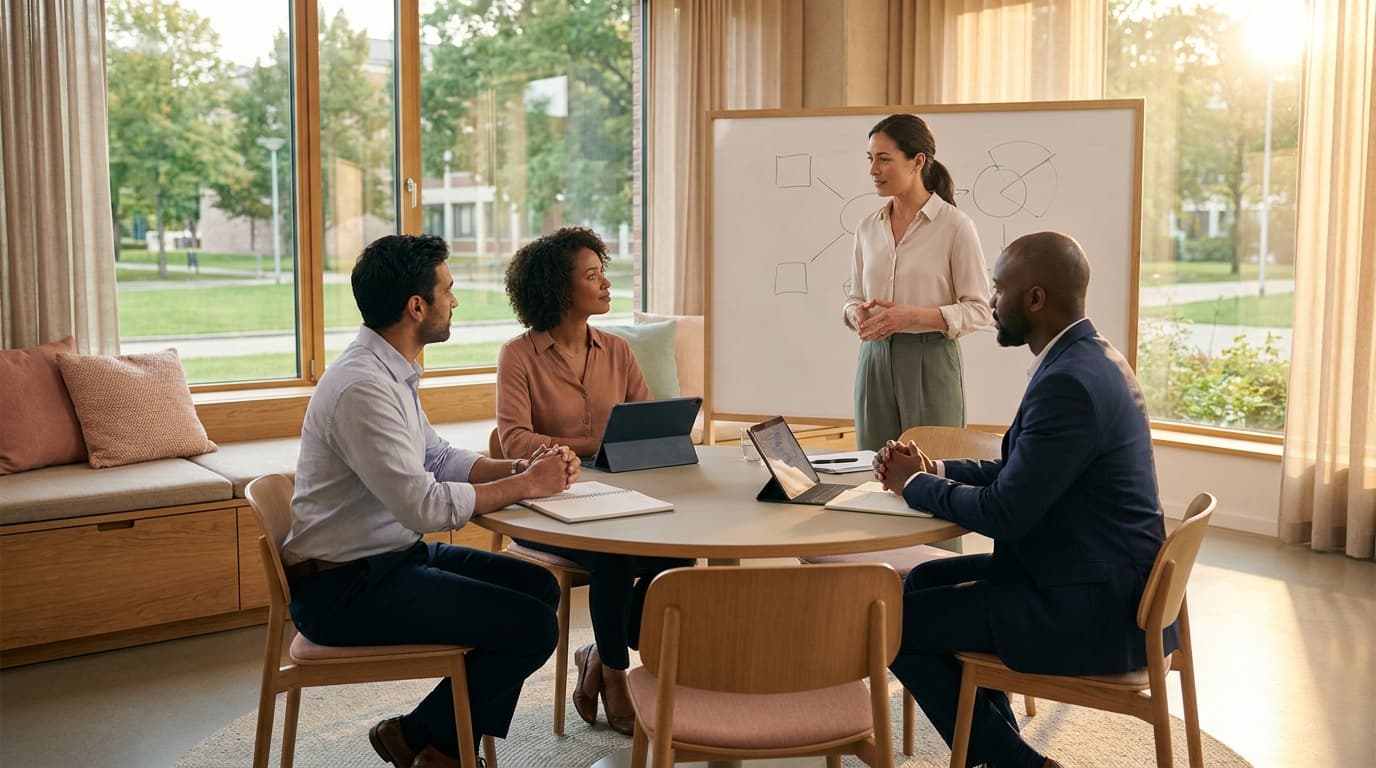
Organizational mediation is a confidential, voluntary process in which a neutral third party helps people in conflict work toward their own resolution. The mediator doesn't act like a judge. The mediator doesn't decide who is right. The job is to guide the conversation, keep it balanced, and help the parties move from accusation to workable problem-solving.
A process with structure and limits
A mediation session is more structured than an informal chat and less adversarial than a grievance hearing. That distinction matters because many leaders confuse mediation with “getting everyone in a room.” Those are not the same thing.
A sound process usually includes:
Pre-session intake: The mediator learns how each person sees the dispute, whether participation is appropriate, and what concerns could block a safe conversation.
Ground rules: The parties agree on how they'll speak, listen, and handle interruptions, confidentiality, and next steps.
Guided dialogue: The mediator helps each party explain impact, interests, and concerns without turning the session into a cross-examination.
Option-building: The discussion shifts from past wrongs to practical changes, commitments, boundaries, or repair steps.
Documented agreements: If the parties reach clarity, the outcome is captured in specific language people can follow later.
Leaders who are new to this area often benefit from plain-language overviews such as LeaveWizard's essential guide, especially when they're trying to distinguish coaching, informal resolution, and mediated dialogue.
The main models leaders should know
The most common workplace style is facilitative mediation. In that model, the mediator helps people communicate more clearly, identify interests, and generate their own options. It's practical and well suited to team disputes, supervisor-employee tensions, and cross-functional misunderstandings.
A second approach is relational mediation. It places more emphasis on recognition, agency, and relationship repair. This can be useful when the parties must keep working or living closely together and need more than a one-time agreement.
Mediation works best when leaders stop treating it like a scripted meeting and start treating it like a disciplined process with clear boundaries.
This isn't a new or experimental practice. The U.S. Postal Service's REDRESS workplace mediation program, with data going back to 1997, is a large-scale example of mediation operating inside a major institution, which shows how mature the model has become over time in organizational settings through the REDRESS research archive.
That history matters. It tells skeptical managers that mediation isn't a trend imported from wellness language. It's an established operational tool.
The Strategic Benefits of a Mediation-Ready Culture
The immediate result of mediation is often modest on paper. Two employees can work together again. A department meeting stops derailing. A student conflict doesn't become a conduct case. But the bigger value is cultural. A reliable mediation pathway tells people the organization takes conflict seriously without treating every dispute like misconduct.
Fair process changes behavior
The strongest institutional case for mediation is tied to procedural fairness. People don't only care about the outcome. They care about whether they were heard, whether the process was neutral, and whether the decision path made sense.
Research on organizational justice links those fairness perceptions with outcomes such as motivation and reduced counterproductive behavior in the review on organizational justice and workplace behavior. That matters for managers because many conflicts leave a residue even when the immediate issue appears resolved. If people think the process was biased or performative, they often comply outwardly while withdrawing effort privately.
A mediation-ready culture improves the odds of a different result. It gives people a fair hearing, a chance to explain impact, and a path toward restoring working relationships without forcing a winner-loser frame.
Why culture matters more than a single case
Organizations benefit when mediation is treated as infrastructure, not emergency response.
Consider what shifts when employees and students know a credible process exists:
Area
What improves
Communication
People raise concerns earlier, before conflict calcifies
Trust in leadership
Leaders are seen as fair process stewards, not just rule enforcers
Psychological safety
Team members speak up with less fear that tension will immediately become disciplinary
Manager effectiveness
Supervisors have an option between avoidance and formal escalation
The culture payoff is strongest in hybrid environments. Remote work hides tension well. People can stay polite on camera while trust erodes in private chats, side emails, and delayed responses. Mediation gives leaders a way to address that hidden layer directly.
If you're trying to make the business case internally, this discussion of the ROI of conflict resolution helps frame mediation as a management capability rather than a last-ditch HR intervention.
When to Use Mediation and When to Investigate
One of the most important judgments in conflict management is knowing when not to mediate. Leaders get into trouble when they treat mediation as a universal sign of fairness. It isn't. In some cases, asking two people to “talk it out” can deepen harm, obscure accountability, or create retaliation risk.
Good fits for mediation
Mediation is usually appropriate when the conflict is primarily interpersonal or relational. The parties may disagree about expectations, communication style, role boundaries, workload distribution, decision-making, or shared-space norms. They may both want the relationship to improve, even if they strongly disagree on what happened.
Typical examples include:
Communication breakdowns: Two colleagues keep misreading tone and intent.
Team friction: A project group has unresolved resentment after a difficult deadline.
Supervisor tensions: A manager and employee are stuck in defensiveness, but there's no allegation requiring formal fact-finding.
Student living conflicts: Roommate or dorm disputes involve behavior, boundaries, and shared expectations.
In these situations, the process works because both sides can participate meaningfully and because future interaction matters.
Red flags that require another path
Mediation depends on consent and impartiality, and it becomes unsuitable when severe power imbalance or systemic policy violations define the issue, as outlined in the UN guidance on effective mediation.
That means leaders should stop and assess before they schedule a session.
Use this decision lens:
Choose investigation when safety is in question: If one party fears retaliation, can't speak freely, or is being pressured to participate, mediation isn't a safe default.
Choose investigation when policy breach is the core issue: Harassment, discrimination, fraud, threats, or other misconduct allegations require formal handling.
Choose investigation when facts must be established: Some disputes aren't about mutual understanding. They're about determining what happened and whether rules were violated.
Choose structural intervention when the problem is systemic: If multiple people report the same issue about workload, bias, leadership conduct, or process design, don't reduce it to one mediated conversation.
For managers handling conduct concerns, practical HR reading on dealing with employee misconduct can help separate behavioral management from mediation decisions.
If one person needs protection more than dialogue, start with protection.
Many institutions stumble on this point. They use mediation because it sounds balanced. Good practice is more disciplined. The right question isn't “Can these people meet?” It's “Can they participate voluntarily, safely, and on reasonably even footing?”
A Step-by-Step Guide to Implementation
A principal has two department heads who have stopped speaking except by copied email. A manager has a remote employee who says every check-in feels corrective. In both cases, the temptation is to book a meeting and hope the conversation resets the relationship. That shortcut usually creates a worse version of the same conflict.
Organizations can start mediation without building a large formal program. They need a repeatable process that people trust. In practice, credibility comes from three things: careful intake, disciplined facilitation, and follow-up that does not fade once the meeting ends.
Start with intake, not the meeting
The joint conversation is the visible part of mediation. The intake work decides whether it has a realistic chance of helping.
Before setting a date, answer three operational questions:
Is mediation workable in this case? Check whether people can participate voluntarily, whether anyone is likely to self-censor, and whether the issue is about a strained working relationship rather than a fact-finding or conduct process.
Who should run it? Internal HR can work well when the parties trust the function and the issue is low on organizational politics. An ombuds office can offer more perceived neutrality. External mediators make sense when seniority gaps, legal sensitivity, or school community visibility could undermine confidence in an internal process.
What must be clear before anyone meets? Set the boundaries early. Participants need to know what stays private, what may be documented, who can approve changes, and what kind of outcome is realistic.
This preparation matters even more with remote and hybrid teams. Video calls compress emotion and context. People interrupt more easily, read tone less accurately, and arrive with very different levels of preparation. An asynchronous step can correct that imbalance because it gives each person private time to sort facts, concerns, and requests before they are reacting live in front of someone they do not trust.
WeUnite is one example of that newer model. The platform supports private perspective-sharing, guided reflection, structured empathy work, and collaborative resolution planning with a saved summary. Used well, tools like this do not replace mediator judgment. They solve an old process problem at scale: one person arrives organized, the other arrives defensive, and the session spends half its time catching up.
Run the session with structure
A good mediation session feels contained. People know the rules, the pace, and the purpose.
Analysts at the EEOC found in its study of mediation processes and outcomes that facilitative mediator behavior and moments of new understanding were common turning points. That tracks with what experienced practitioners see every week. Conflict often shifts once the parties hear specific information they did not have, or hear familiar information framed in a way they can finally absorb.
The mediator should actively manage that process by:
Controlling pace: Slow the exchange enough to stop rehearsed accusations and get to concrete examples.
Clarifying interests: A demand for copied emails, stricter check-ins, or written sign-off often signals a concern about trust, visibility, or role confusion.
Testing assumptions: Many disputes survive on unverified stories about intent, policy, authority, or workload.
Checking feasibility: An agreement that sounds fair but ignores staffing levels, school schedules, reporting lines, or manager discretion will fail quickly.
A short explainer can help teams visualize the live process before they try it.
A useful session produces clearer understanding and actions people can actually carry out.
Treat follow-up as part of the intervention
Many mediation efforts fail after an apparently productive meeting. The conversation goes well, nobody writes down specifics, and old habits return within two weeks.
Follow-up needs its own structure:
Write down commitments: Record who will do what, by when, and what counts as completion.
Set review dates early: A check-in scheduled at the close of the session is more reliable than a vague promise to reconnect if needed.
Define the next route: If the agreement stalls, people should know whether the next step is manager coaching, a second mediation, role clarification, or formal HR action.
Review patterns across cases: Repeated disputes about workload, unclear authority, meeting conduct, or parent communication often point to design flaws, not just interpersonal friction.
Traditional mediation practice needs updating. In a single-site office, a manager might notice whether the temperature has dropped. In distributed teams and school systems, deterioration is easier to miss until it shows up as absence, turnover risk, or a parent complaint. A scalable process, supported by clear documentation and private digital tools, helps organizations protect confidentiality while still keeping implementation on track.
Measuring Success and Upholding Best Practices
A closed case tells you almost nothing by itself. People can leave a session with an agreement and still re-enter conflict a month later. They can also leave without a formal agreement but with enough clarity to work together effectively again. That's why organizations need a broader success model.
Measure more than closure
Useful evaluation focuses on what happened after the conversation, not just inside it.
Track indicators such as:
Repeat conflict patterns: Does the same issue return between the same people or in the same unit?
Implementation quality: Were agreed actions completed, and were they specific enough to follow?
Perceived fairness: Do participants report that they were heard, treated neutrally, and able to participate meaningfully?
Escalation movement: Did the issue move into grievance, conduct, turnover risk, parent complaints, or student affairs intervention later?
Systemic themes: Are similar cases pointing to a shared policy, leadership, or workflow problem?
For schools and large employers, aggregated trend review matters almost as much as individual case outcomes. A cluster of “resolved” mediations around scheduling, disrespect, or unclear authority may signal a recurring management design issue, not just isolated conflict.
Protect the process in digital settings
Best practice begins with confidentiality, neutrality, and clear consent. Digital tools don't remove those duties. They make them more operational.
When mediation uses online forms, asynchronous reflection, video meetings, or AI-guided prompts, leaders should be explicit about:
Governance area
What to define
Privacy boundaries
What is stored, who can access it, and what remains confidential
Role clarity
Whether the platform supports reflection, facilitation, documentation, or all three
Escalation criteria
Which disclosures trigger HR, safeguarding, compliance, or conduct review
Human oversight
Who reviews appropriateness and who handles exceptions
Organizations also need to avoid a common digital mistake. Convenience can tempt leaders to skip suitability screening. A private online intake can help people prepare, but it can't substitute for judgment about coercion, power imbalance, or legal risk.
Good practice is simple to state and hard to maintain. Keep the process voluntary where appropriate. Protect sensitive information. Define when mediation stops and another procedure starts. And review patterns at the system level so you're not solving the same conflict over and over in slightly different forms.
Organizational Mediation in Action
A hybrid product team had stopped trusting each other after months of friction over response times and meeting decisions. One group felt excluded from informal office conversations. The other felt micromanaged by long message threads and repeated follow-ups. Their manager first tried separate coaching, but the underlying problem was shared interpretation, not just individual behavior.
A mediated process helped because it slowed the conflict down. Each person could explain what certain habits meant to them, not just what they disliked. An asynchronous reflection tool helped the parties prepare before the live meeting, which reduced defensiveness and made the joint discussion more specific. They finished with a simple communication charter covering handoffs, meeting notes, and when urgent requests belonged in chat versus email.
A university housing example looks different on the surface but follows the same logic. Two students in a dorm were in repeated conflict about noise, guests, and use of common space. Staff could have pushed the issue straight into a conduct pathway. Instead, a peer-supported mediation gave them a structured chance to define boundaries and clarify what respectful shared living looked like. The agreement was practical. Quiet hours, guest notice, and a method for raising concerns before involving staff.
Neither example required people to become close. That's another point leaders sometimes miss. Organizational mediation doesn't aim for friendship. It aims for enough understanding, fairness, and structure that people can function well together.
If your team, school, or institution needs a more private and scalable way to handle conflict, WeUnite offers an AI-guided mediation process built around perspective sharing, neutral reflection, empathy-building, and collaborative resolution planning. It can support early intervention before disputes harden, while giving people a structured space to prepare and communicate more clearly.
📺 Watch & Learn
Video: Organizational Mediation: Your Guide to Resolving Conflict
Deepen your understanding with this curated video on the topic.