School Conflict Resolution: A Guide for Modern Educators
← Back to Blog
🏫 K–12 Schools

School Conflict Resolution: A Guide for Modern Educators

May 13, 2026·18 min readschool conflict resolutionpeer mediationrestorative justice

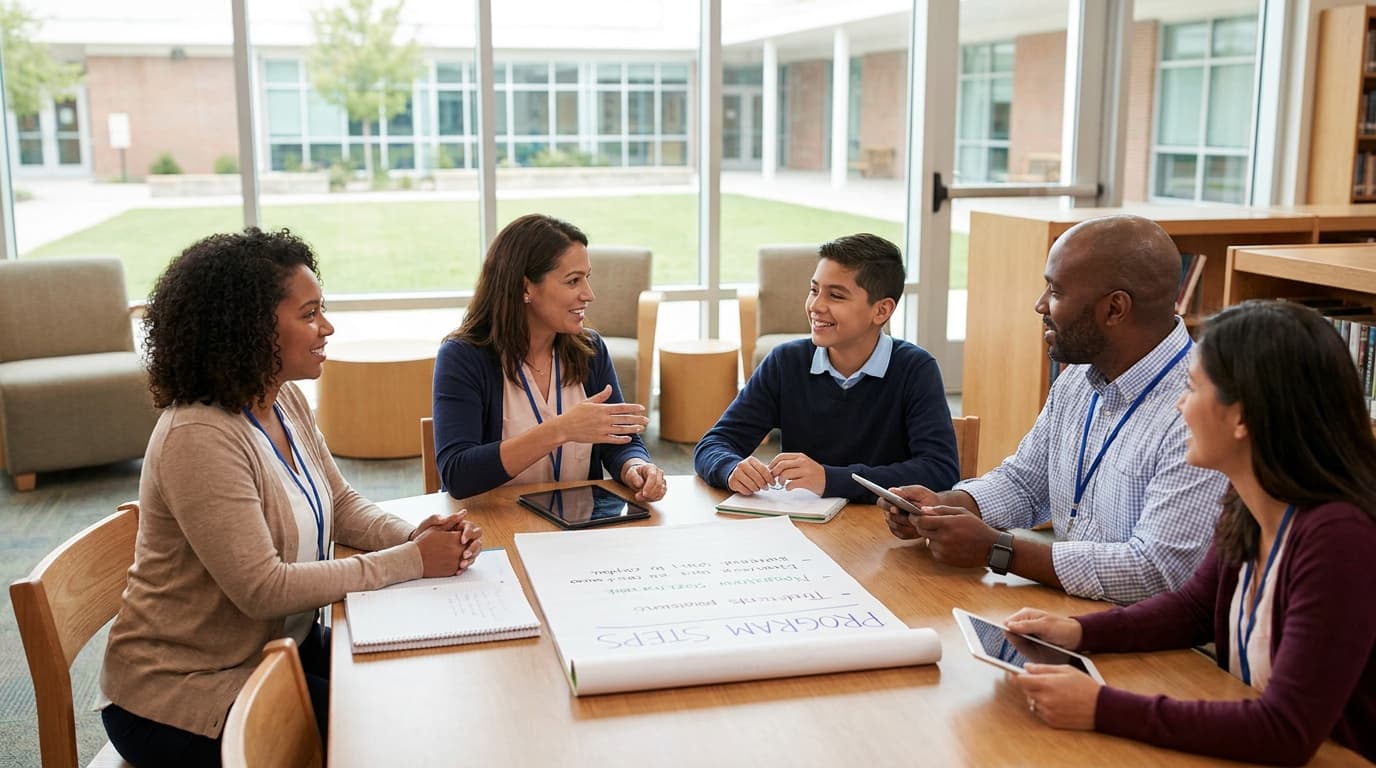
A teacher has just settled the class after lunch when two students start arguing over a comment made during group work. One says it was a joke. The other is already standing, voice raised, backpack half-zipped, ready to leave the room or push back harder. Within minutes, the issue has spread. Friends are taking sides, instruction has stopped, and an assistant principal is now spending part of the afternoon on something that began as a small social rupture.

That scene is ordinary in schools. It's also where school conflict resolution either lives on paper or proves its value in practice.

In healthy schools, conflict isn't treated as proof that students are failing. It's treated as evidence that students need skill, structure, and adult guidance. The shift matters. When schools move from “stop the problem” to “teach the response,” discipline becomes more precise, classrooms get steadier, and students build tools they'll use long after graduation. That's true for classic peer mediation programs, and it's even more relevant now as schools address digital communication, neurodiversity, equity concerns, and new tools that can support de-escalation outside the counselor's office.

From Hallway Arguments to Teachable Moments

A lot of student conflict starts with something adults are tempted to dismiss. A look in the hallway. A seat taken at lunch. A teammate who didn't do their share. The visible behavior arrives late in the story. By the time students are loud, one of them usually feels embarrassed, excluded, disrespected, or trapped.

That's why effective school conflict resolution starts before the formal meeting. Adults need to slow the sequence down. Separate students if needed. Lower the audience effect. Help each student get regulated enough to talk. Then the adult decision becomes clearer. Is this a brief coaching moment, a classroom repair conversation, a peer mediation referral, or a safety issue that needs direct administrative action?

In practice, schools get into trouble when they rely on a single response for every kind of conflict. Some staff overuse consequences. Others overuse open-ended dialogue. Neither works by itself. Students need boundaries and relationship repair.

What makes conflict teachable

Conflict becomes teachable when the school names the skills involved rather than only the rule that was broken. Those skills usually include:

  • Emotional regulation: Students need a way to pause before they explain.
  • Perspective-taking: Each student has to hear impact, not just defend intent.
  • Clear expression: Vague complaints escalate quickly. Specific statements calm things down.
  • Problem-solving: Students need help moving from blame to workable next steps.

Practical rule: If a student is still trying to win, they're usually not ready to solve.

A mature conflict resolution program doesn't promise a friction-free school. It creates repeatable ways to handle friction without letting it dominate the day. That can look formal, such as a mediation referral process, or informal, such as a teacher using a brief restorative check-in after recess. Either way, the message is consistent. Conflict is real, but it's manageable.

What busy schools need most

The schools that sustain this work don't depend on one charismatic counselor. They build habits across classrooms, offices, and common spaces. Students hear similar language from adults. Staff know when to intervene and when to facilitate. Administrators protect time for the process instead of treating it as an add-on.

That consistency is what turns hallway arguments into teachable moments instead of repeat incidents.

The Four Core Models of School Conflict Resolution

Traditional discipline asks, “What rule was broken, and what consequence follows?” Conflict resolution asks a different question. “What happened between these people, what skills are missing, and what process will help them repair or move forward safely?”

A conceptual sketch showing a balance scale weighing a wooden judge's gavel against a pink heart.

That shift didn't happen by accident. National data showed a 21 percent increase in school crime despite higher safety spending, and four evidence-based approaches became widely adopted: peer mediation, process curriculum, peaceable classrooms, and peaceable schools. The same source also notes that about 60% of employees never received basic conflict management classes during their education, which is a strong argument for teaching these skills early in school life through this overview of conflict resolution in schools.

Why schools moved beyond punishment alone

Punitive discipline still has a place. Schools need firm responses for threats, harassment, coercion, and violence. But punishment alone often stops behavior temporarily without building the capacity students need for the next disagreement.

That's why many schools blend accountability with instruction. A student may still face a consequence, but the school also teaches how to listen, speak clearly, regulate emotions, and repair harm. If teachers want practical classroom materials to support that work, a resource like lesson planning for conflict resolution can help translate the philosophy into actual classroom activities.

What each model actually does

Here's the cleanest way to distinguish the four models.

Model Best use Core idea
Peer mediation Recurring student-to-student disputes Trained students help peers talk through conflict in a structured way
Process curriculum Classroom instruction Conflict skills are taught directly, like any other competency
Peaceable classrooms Daily classroom climate Teachers build norms, routines, and language that reduce escalation
Peaceable schools Whole-school culture The entire building aligns policies, expectations, and adult practice

Peer mediation is the most visible model because it's concrete. Students can be trained, referrals can be made, and agreements can be documented. It works well for many interpersonal disputes, especially when both students can participate voluntarily and safely.

Process curriculum is quieter but often more durable. It teaches negotiation, listening, emotion language, and problem-solving during regular instruction. Students don't have to wait for a conflict to learn what to do in one.

Peaceable classrooms focus on the teacher's daily choices. How are rules created? How are minor disagreements interrupted? What language do students hear when they're upset? That management layer often determines whether issues stay small.

Peaceable schools expand that logic across the building. Office staff, lunch monitors, counselors, and administrators respond with similar principles. Schools considering a broader restorative approach often find it useful to connect this work with restorative justice in schools, especially when they're aligning discipline systems and culture work.

Schools struggle when they treat peer mediation as the whole program. It works better as one visible part of a larger culture.

Why Invest in Conflict Resolution Evidence and Benefits

School leaders usually don't need a philosophical argument. They need a practical one. Will this help with behavior, learning, and staff time, or will it become one more initiative that fades after a semester?

The strongest answer comes from long-running, extensive models. An early school-based conflict resolution approach that began in 1966 used a twelve-year spiral curriculum and trained students across grade levels in problem-solving negotiation and mediation. Research on schools using extensive programs documented improvements that matter to any principal or school psychologist: students showed increased class attendance, more pro-social behavior, less aggression and disruption, lower likelihood of dropping out, improved problem-solving, and stronger academic outcomes including higher achievement test scores and grades, as described in this review of conflict resolution education in schools.

A hand-drawn illustration showing a line graph where a small plant grows as it makes progress.

Academic and behavioral returns

The academic gains aren't surprising when you've worked in schools. Students learn less when they spend cognitive energy on social threat, retaliation, or unresolved tension. When a school teaches constructive conflict habits, instruction is interrupted less often and students return to learning faster.

Behaviorally, the benefit is precision. Instead of treating every incident as defiance, schools start distinguishing between dysregulation, social misunderstanding, peer status struggles, and genuine aggression. That leads to better interventions.

A practical way to think about the evidence is to group the benefits this way:

  • For students academically: Better attendance, stronger learning skills, and improved performance.
  • For students socially: More pro-social behavior, better coping, and stronger problem-solving.
  • For the school climate: Less disruption and a stronger sense of community.
  • For long-term outcomes: Higher motivation and educational aspiration.

The staff impact schools often underestimate

The most overlooked benefit is adult bandwidth. Teachers don't just lose time during the argument itself. They lose momentum before it starts, during the reaction from peers, and afterward as they repair the room.

A conflict system earns its keep when it gives adults a repeatable response under pressure.

That's why investment decisions should focus less on whether every conflict disappears and more on whether the school gets better at containing, teaching, and resolving ordinary disputes. In strong implementations, staff spend less energy improvising and more energy teaching.

Schools also tend to see a culture change among adults. When students know there is a fair process, they're less likely to turn every grievance into public drama. When teachers know how to triage conflict, they're less likely to over-refer or under-respond. That steadiness is hard to measure in one meeting, but it's easy to feel across a semester.

Designing Your School Conflict Resolution Program

Programs fail when schools start with training before they answer basic design questions. Who owns the work? Which students is it for? What conflicts belong in mediation, and which don't? Where will conversations happen? How will teachers refer students without adding paperwork they'll avoid?

A pyramid diagram illustrating the three steps of strategic program design for educational initiatives.

A strong program begins with architecture, not enthusiasm.

Start with who owns the work

Every school needs a small steering group. In most buildings, that means an administrator, counselor or psychologist, a teacher representative, someone from student support, and at least one staff member who understands the informal life of the school, often a dean, behavior specialist, or trusted campus supervisor.

Define roles early:

  • Program coordinator: Manages referrals, training schedules, documentation, and review.
  • Staff facilitators: Handle complex mediations, supervise student mediators, and screen referrals.
  • Teacher partners: Use common classroom language and flag patterns early.
  • Family communication lead: Explains the process to caregivers and manages concerns.

Without role clarity, schools drift into a vague “everyone supports it” model. That usually means no one owns follow-through.

Choose a model that fits your building

Not every school should launch with the same design. An elementary school may start with classroom routines and explicit skill teaching. A middle school may need a mix of teacher-led conflict coaching and structured peer mediation. A large high school often needs tiered options because not every dispute can wait for a formal session.

Evaluations of multi-component conflict resolution education programs found 64% gains in social skills, 70.3% gains in empathy, and that schoolwide check-in/check-out for at-risk students can yield a 30% behavior improvement, according to this analysis of conflict resolution on the playground and beyond. The practical lesson isn't just that programs help. It's that multi-pronged designs outperform isolated activities.

A useful planning lens is:

  1. Universal layer: Classroom norms, routine language, and direct instruction for all students.
  2. Targeted layer: Check-in systems, small groups, and adult-facilitated problem-solving for students with repeated conflict.
  3. Intensive layer: Formal mediation, behavior support, counseling, or administrative intervention for higher-stakes cases.

Schools looking for implementation ideas across grade bands may find conflict resolution strategies for K-8 schools useful when they're adapting routines for younger students.

Build buy-in before the first training

Teachers often resist because they think conflict resolution means one more meeting and less accountability. Families sometimes worry it means students are being forced to reconcile. Both concerns are understandable. Address them directly.

Use plain language in staff meetings and family communication:

  • This is not a replacement for safety procedures.
  • Participation rules must be clear.
  • Some conflicts are appropriate for mediation. Some are not.
  • The aim is fewer repeat incidents and stronger student skills.

Buy-in grows when staff see that the program reduces chaos instead of adding theory.

Pilot first if the building is skeptical. One grade level, one team, or one lunch period is enough to expose weak referral systems and scheduling problems. Schools learn quickly whether they have private space, enough adult supervision, and a realistic way to protect instructional time.

Good design feels almost boring on paper. That's a compliment. Predictable systems are what make the relational work possible.

Training Mediators and Establishing Protocols

Student goodwill isn't enough. If a school wants mediation to work, mediators need training, adults need screening criteria, and everyone needs a shared protocol that holds up on a hard day, not just in a workshop.

A pencil sketch of two hands holding two wooden blocks labeled Roleplay and Active Listening being connected.

What mediators need to learn

The strongest training includes skill rehearsal, not just explanation. Student mediators need repeated practice with realistic scenarios. Staff facilitators need the same, plus better judgment about risk, confidentiality, and power imbalance.

Core training topics usually include:

  • Active listening: Tracking both content and emotion without jumping to advice.
  • Neutral language: Avoiding blame words, loaded summaries, and subtle favoritism.
  • Interests versus positions: Helping students move from “I want an apology” to “I want to feel safe and respected.”
  • Reframing: Turning accusations into concerns that can be addressed.
  • I-statements: Giving students a usable structure when emotion is high.
  • Cultural awareness: Understanding how communication style, status, and identity affect conflict.
  • Roleplay under pressure: Practicing what to do when one student shuts down, cries, or tries to dominate.

Schools developing student mediator systems can compare their approach with peer mediation in schools, especially when deciding how much structure students need before they lead sessions.

The protocol matters more than enthusiasm

A mediator should never have to improvise the sequence. The process should be stable enough that students know what to expect.

A basic protocol often looks like this:

  1. Referral and screening
    An adult reviews whether the issue is appropriate for mediation.

  2. Separate intake
    Each student gets a brief private check-in to tell their version and confirm willingness.

  3. Ground rules
    No interrupting, no threats, no insults, and either person can request a pause.

  4. Story sharing
    Each student speaks without interruption.

  5. Clarifying and reframing
    The mediator checks facts, feelings, and points of misunderstanding.

  6. Problem-solving
    Students generate options and agree on specific next steps.

  7. Closure and follow-up
    Adults document the agreement and check back later.

Here's a useful demonstration format for staff teams to discuss before launch:

When mediation is not the right response

Often, schools apply mediation indiscriminately. Mediation is not a universal solution. It is inappropriate when there is intimidation, ongoing bullying with a power imbalance, credible threat, coercion, sexual harm, severe harassment, or a student who cannot participate voluntarily and safely.

Use a simple screening table.

Situation Mediation fit
Misunderstanding between peers Usually appropriate
Group work dispute Often appropriate
Social media argument with mutual participation Sometimes appropriate, with adult review
Repeated targeting of one student Usually not appropriate
Threats or physical aggression with safety concerns Not appropriate
Significant power imbalance Not appropriate without a different process

If one student is afraid to say no, the school isn't looking at a mediation case. It's looking at a protection and accountability case.

Protocols should also cover consent, documentation limits, caregiver communication, and what happens if a session fails. The goal isn't to make the process rigid. The goal is to make it safe enough that adults can trust it and students can use it.

Sample Conflict Resolution Session Flows and Scripts

A lot of educators understand the principles of mediation but still wonder what the conversation sounds like. That's a fair concern. A workable process should be simple enough to use in a noisy school day and structured enough that students don't drift back into arguing.

A simple in-person peer mediation flow

The evidence for peer mediation is strong when the process is structured. A meta-analysis of 23 peer mediation studies involving 4,327 mediations found a 93% agreement rate, and 96.4% of educators reported positive school-wide impacts, including 77.5% less staff time spent on conflicts, in this review of resolving conflict in schools.

A practical script might sound like this.

Mediator opening
“Thanks for being here. My job is to help both of you talk this through fairly. I'm not here to pick a side. We'll take turns, speak respectfully, and pause if either of you gets too upset to continue.”

Ground rule check
“Can both of you agree to let each other finish without interrupting?”

Student A speaks
“When you told the group I never do my part, I felt embarrassed because everyone heard it, so I need you to talk to me privately if there's a problem.”

Mediator reframes
“You felt publicly embarrassed and want concerns brought to you directly.”

Student B speaks
“I was frustrated because I thought you ignored my messages, and I didn't know what else to do.”

Mediator moves to shared problem
“So one issue is unfinished work. Another is how the concern got raised. Let's solve both.”

That middle move matters. Students often arrive arguing about the last comment, while the conflict is missed communication, exclusion, or status threat.

How an AI-assisted flow can support the process

In schools, the biggest obstacle is often timing. The adults are busy, the students are flooded, and the conflict continues after the bell. That's where digital tools can support the process if the school uses them carefully.

A structured AI-guided flow can begin with private reflection instead of immediate confrontation. One student types what happened. The system reflects back the content neutrally, asks clarifying questions, and slows impulsive language. Then the second student does the same. Only after both perspectives are clarified does the process move into empathy-building and collaborative planning.

A school might use a flow like this:

  • Private perspective sharing: Each student explains the event without an audience.
  • AI mirroring: The tool reflects the student's meaning back and prompts clearer wording.
  • Empathy stage: Students review each other's concerns in a calmer format.
  • Resolution planning: The system helps generate specific agreements and saves a summary.

That format can be especially useful when students need space before they can speak face-to-face. It can also help staff identify when a student isn't ready for joint dialogue.

One option schools are exploring is WeUnite, an AI-guided mediation platform that follows a four-phase structure of private perspective sharing, neutral AI reflection, guided empathy building, and collaborative resolution planning with a saved summary. In a school setting, that kind of tool can support pre-mediation reflection, help students clarify language, and preserve continuity when a conversation has to pause and resume later.

The value of technology isn't that it replaces adults. It gives students a calmer first draft of the conversation.

The caution is straightforward. Schools still need adult oversight, consent rules, and clear boundaries for which conflicts can enter a digital process at all.

Measuring Success and Ensuring Equity

The schools that sustain conflict resolution work don't ask only, “Did students reach agreement?” They ask whether agreements hold, whether repeat conflicts drop, whether staff are using the system correctly, and whether the process works for students who don't communicate or regulate in typical ways.

Measure what schools can actually improve

Most schools don't need complicated dashboards. They need a short list of indicators they'll review.

Useful measures include:

  • Referral patterns: Which grades, locations, or times of day generate the most conflict referrals
  • Agreement durability: Whether students are still following the agreement after a brief check-in
  • Repeat incidents: Whether the same students return with the same problem
  • Classroom disruption trends: Whether teachers report quicker recovery after conflicts
  • Climate feedback: Whether students and staff describe the process as fair and useful

If the school uses digital tools, it's worth building a routine for periodic review. This kind of measuring conflict resolution impact in schools becomes much easier when leaders define success before the pilot begins.

Equity means adapting the process

Standard approaches often fail the students who most need a thoughtful response. That's especially true for neurodiverse students. A 2025 UK trial found that customized empathy-building and tools with a “SafePause” for solo processing reduced escalation by 45% for this student population compared to traditional methods, as noted in this discussion of conflict techniques for school children.

That finding matches what many practitioners see. Some students need visual supports. Some need extra processing time. Some communicate more clearly in writing than in live dialogue. Some can manage a short problem-solving exchange but not a long face-to-face emotional conversation.

Adaptations may include:

  • Visual sequencing: Show each step of the mediation process.
  • Private pre-processing: Let students organize thoughts before the joint session.
  • Reduced verbal load: Use shorter prompts and concrete language.
  • Regulation options: Build in pauses, movement, or quiet recovery time.
  • Alternative expression: Permit written responses or supported communication.

Privacy and scale

Digital support raises a separate issue. Schools need plain rules about who can access summaries, how long records are kept, when caregivers are informed, and when a concern triggers mandatory reporting or administrative review.

Scaling also deserves caution. A pilot can feel successful because the adults involved are unusually skilled. District-wide growth requires training quality, referral standards, privacy practices, and adaptation for different age groups. Expansion should follow readiness, not enthusiasm.

A conflict resolution system becomes credible when students trust it, staff use it correctly, and vulnerable students aren't forced into a process that doesn't fit how they think or communicate.


Schools don't need more reactive discipline alone. They need a repeatable way to help students slow down, speak clearly, and repair harm when that's possible. WeUnite offers one structured option for schools that want AI-guided support for reflection, empathy-building, and resolution planning alongside adult oversight.

📺 Watch & Learn

Video: School Conflict Resolution: A Guide for Modern Educators

Deepen your understanding with this curated video on the topic.

▶ Watch on YouTube

More From the Blog

How to Express Feelings Safely and Effectively
🏢 Enterprise

How to Express Feelings Safely and Effectively

Learn how to express feelings with our step-by-step, evidence-informed guide. Improve communication in your relationships, at work, and at home. Start today.

June 15, 2026 · 14 min read

Master Mediation Conflict Resolution Training
🏢 Enterprise

Master Mediation Conflict Resolution Training

Explore our complete guide to mediation conflict resolution training. Learn skills, compare formats, and implement programs for workplace, school, or community.

June 14, 2026 · 15 min read

Disclaimer

WeUnite is not a licensed counseling or therapy service, and the people behind it are not counselors, therapists, or mental health professionals. The content on this website and blog reflects the personal views, lived experiences, and common-sense perspectives of our contributors — everyday people who believe conflict can be resolved with empathy, not escalation. Nothing here should be taken as a substitute for professional mental health, legal, or crisis intervention services. If you or someone you know is in immediate danger or distress, please contact a licensed professional or emergency services.

A note on AI-generated content: Artificial intelligence is used to help draft, develop, and refine articles on this website and blog. While AI assists in the content creation process, each article is shaped by the views, values, and editorial direction of our founders and contributors. We are committed to transparency about this and believe that using AI responsibly — in service of authentic human connection — is consistent with everything WeUnite stands for.